
About
I'm Grace, a New York-based psychotherapist and Licensed Master Social Worker practicing at Manhattan Mindful. I earned my Master of Social Work from New York University and am currently pursuing advanced postgraduate training in psychoanalytic theory and clinical practice at the Institute for Contemporary Psychotherapy.
Before entering the field of psychotherapy, I studied art history and studio art and worked as an artist and educator. My background in the arts continues to inform how I approach my work, particularly my interest in the ways we understand ourselves, make meaning of our experiences, and navigate the complexities of our relationships.
My clinical approach is rooted in contemporary psychodynamic and psychoanalytic thinking, with an emphasis on curiosity, collaboration, and the therapeutic relationship. I believe meaningful therapy makes room for complexity, contradiction, and the parts of ourselves that may be difficult to understand or put into words. I bring warmth, openness, and a sense of humor to my work, and I value creating a relationship in which clients feel comfortable exploring their experiences without the expectation of having everything figured out.
Clinical Training & Education
Institute for Contemporary Psychotherapy (ICP)
Candidate, Four-Year Psychoanalytic Training Program
Advanced postgraduate training in psychoanalytic theory and clinical practice
New York University, Silver School of Social Work
Master of Social Work (MSW) | 2026
Manhattan Mindful
Psychotherapist
Individual psychotherapy informed by contemporary psychodynamic and psychoanalytic approaches.
Art & Therapy
Art has always been an important part of my life, both as something I practice and something I love studying and sharing with others. I studied art history and studio art in college, and before becoming a therapist, I spent time working as an art educator, including at the Museum of Fine Arts in Boston, where I led gallery tours and taught art classes for children.
One of my favorite parts of teaching was watching how differently people could experience the same work of art. A painting that seemed unremarkable to one person could spark an entirely different conversation with someone else. I loved hearing what children noticed, the questions they asked, and the stories they imagined. Often, the most interesting conversations came from observations I never would have thought to make myself.
Looking back, I can see how much those experiences shaped my interest in psychotherapy. Both art and therapy invite us to slow down, pay attention, and become curious about what might exist beneath the surface. Neither requires us to arrive at a single correct interpretation. What we notice, what we overlook, and the meanings we make are inevitably shaped by our own histories and experiences.
I still make art, visit museums, and find myself drawn to the ways creative expression can communicate things that aren't always easy to put into words. Although my professional path has evolved, that curiosity has remained remarkably consistent. In many ways, becoming a therapist has felt less like leaving art behind and more like finding another way to explore the questions that drew me to it in the first place.
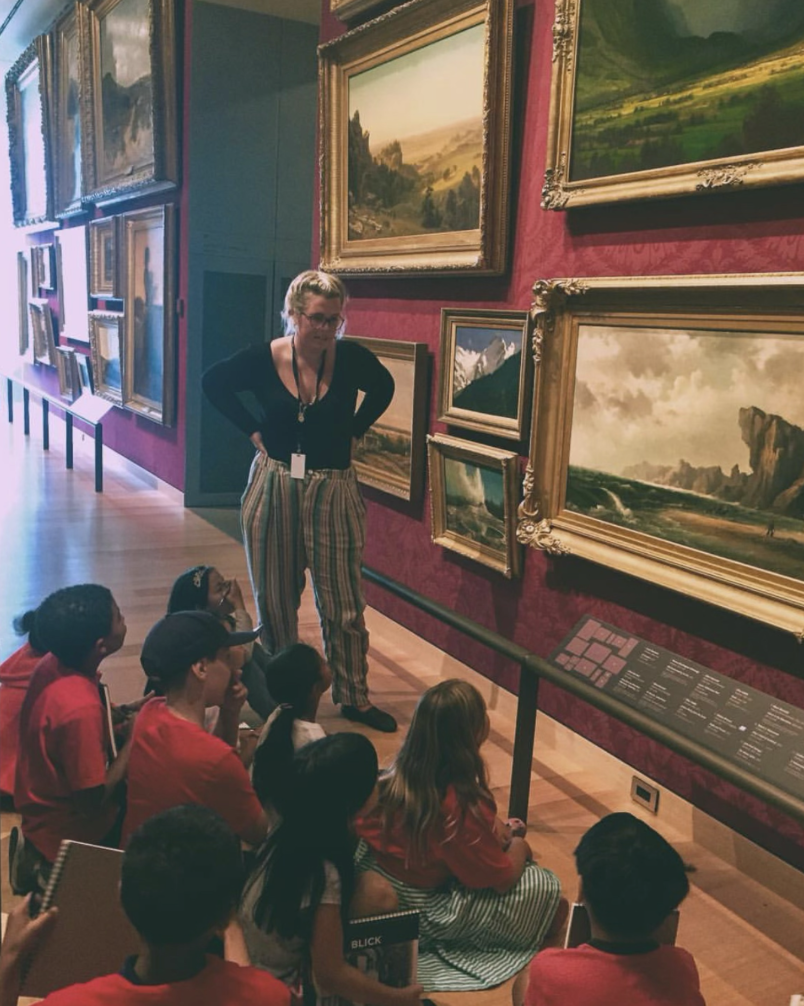
Leading a gallery discussion with young students at the Museum of Fine Arts, Boston.